
There are loads of really good models describing student engagement in higher education. Essentially, all these models seek to explain how the interaction between the learner, their institution and broader society influences student success. Pascarella & Terenzini (2005) describe them as ‘college impact models’.
They’re all useful, all interesting, and inevitably, all inaccurate (to some extent). So I’m going to add another one.
Before I do, here’s a quick summary of Student Engagement models.
My personal favourite remains Astin’s (1993) IEO model – Inputs x Experience = Outcomes. You’ve got to love the brevity, but there’s a lot of interesting work underpinning it. If you’re reading this blog, you’re probably familiar with Tinto’s (1993) model of longitudinal departure (students decision to remain or stay is based on the interaction between personal characteristics, experience, goals and the institutional/ social environment). Perhaps less familiar will be Kuh. et al’s., (2007) ‘What matters in student success’ model. Their more-complex model positions student engagement at the core, but it’s shaped by prior experience, student behaviours and institutional conditions. We use Harris et al’s (2004) model as the basis for our learning analytics work. They suggest that engagement has four elements: cognitive, affective, relational and conative (time on task). I’ll always refer to Bryson’s (2014) black box model that seeks to illustrate the complex iterative nature of engagement through messy interactions between elements including physical space, opportunities to engage and students being ready to engage. Solomonides, Reid and Petocz (2012) take a slightly different approach and focus on the student’s sense of themselves, both the current sense of being and the dynamic sense of transformation. Most recently Lowe (2023) draws upon Trowler’s 2010 model to suggest that students engage behaviourally, emotionally and cognitively and that engagement needs underpinning by student involvement in educational development.
Anyone working in the sector will find these (and plenty of other models) thought-provoking and hopefully inspiring. Please go and have a read, but I want to suggest that they all (to a greater or lesser extent) skip over the question of ‘what does a student need to do in order to engage with their studies?’.
So…
What does a student need to do to engage with their studies?
I’m looking at this model from the perspective of the competences or personal capabilities that a student needs in order to effectively engage with their studies. No student will possess all of them at the start of their time at the institution. Many won’t know that they lack competence and some will be mistaken in thinking that they are more proficient or capable than they actually are. I’m aware that I am positioning engagement as a thing that the student has to do. I think that’s crucial: no student should be able to complete their studies without engaging with learning and completing assignments, but I cannot stress strongly enough, that (like all the models above) institutions and lecturers play a crucial role. Institutions provide services and resources and connect together the support; lecturers are responsible for guiding and inspiring students and helping them to understand the rules and expectations of the new environment.
NB, this is a model in development, the boundaries between the different elements are fuzzy, and may always be, but I think that there may be something important to discussing elements of this with students during induction. It definitely doesn’t explain the whole dynamic process of student engagement, but is intended to fill a gap that I believe exists in the existing models.
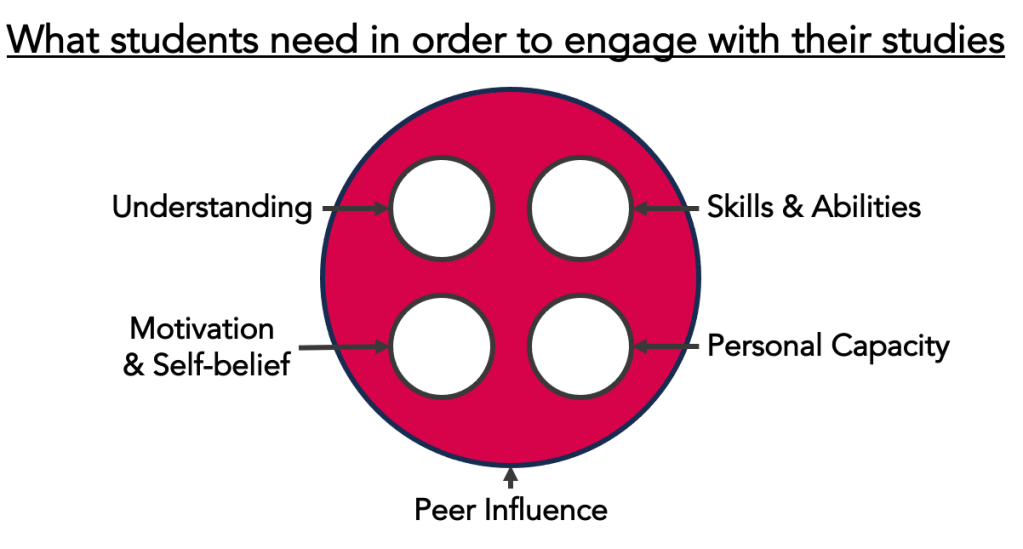
Understanding
The first capability students need is to understand the rules and expectations upon them. One of the challenges, particularly for new students is that it looks largely the same as prior stages of education, but there are very profound differences.
- Are deadlines fixed or flexible?
- What does ‘good’ work look like?
- What is a personal tutor & when am I supposed to use them?
- How do these different pieces of knowledge fit together/ how do I put this all together for an assignment?
Of course this is boring. You know it, you’ve lived the cycle many times and had to explain it many times to new students, but without some of these essential pointers, students will stumble at the first hurdle. The information will be available in course handbooks, and in the VLE/LMS, but some of these concepts do need discussing and making live as part of inductions and as students get ready for the ‘firsts’ (first group work, first assignment, first exam etc.).
Skills and Abilities
If a student understands what they need to do, they may still fail to do it because they simply don’t know how to. Students need to develop the skills and abilities required to work together effectively and complete the required coursework. In some instances it will be relatively easy for students to identify that they need to develop new skills (for example using a piece of scientific equipment), but often it’s much harder as universities normally expect students to develop existing skills and approaches, not pick up completely new ones.
Motivation and Self-belief
Even if a student understands what is required and has the ability to do it, they may still fail to engage through a lack of confidence, or because they simply aren’t motivated. I believe strongly that every academic needs to adopt the mantra that All Students Have Imposter Syndrome! (you know it’s serious if I add an exclamation mark). Teaching this way ought to help a lot of students.
If students can develop some self-belief in their own abilities, that they are coping with the expected work, they can potentially overcome the worst aspects of imposter syndrome. I’d argue that can only come from elements such as the cognitive lightbulb moments associated with grasping new concepts, from positive interaction with peers and with teaching staff. We can do more though. In the same way that I’ve suggested above, we need to help students understand each of the firsts, we can also celebrate each of those firsts. We ought to celebrate completing the first lecture, the first group task etc. We can potentially help grow students’ confidence by periodically pausing and looking back. What new knowledge do students possess half way through the first term compared to the start? Similarly, recapping the last lecture, or scaffolding learning tasks gives students opportunities to grow in confidence.
Motivation may be even harder, students may be generally motivated to be on the course, but not motivated to attend a class if it’s ‘boring’ or attempt a piece of coursework if it’s too challenging. Scaffolding assessments has the potential to help, but so do reminders about deadlines, feedback or testimonials from students who have completed the assessments. In some cases encouraging students to access more specialist help may also be useful
Personal Capacity
Even if a student understands what is expected, has the necessary skills and self-belief, they may still be unable to engage due to barriers from their personal circumstances. These barriers may include financial hardship or family commitments. It may be possible to alleviate some of the barriers through the approaches above, but students may be facing significant challenges that require specialist support. Clearly, in the HE model, the student is responsible for seeking out help, but I want to argue that teaching staff have a role to play. This includes normalising help-seeking behaviour and promoting the services available.
I’ve had some interesting feedback on this element (thank you for the comments in LinkedIn). I’ve viewed this section (like all them) as a problem that needs to be fixed. My conception is that each student needs to understand what their specific structural barriers are to learning and they need to seek out help or develop strategies for overcoming them. This might be true, but it’s also quite deficit in approach and potentially ‘othering’ to students from non-traditional backgrounds. Personal capacity can also refer positively to the resources and support available to the student (a little like the NEF wellbeing model). I need to re-think this slightly.
Peer Influence
I think that the final element of the model is the role of peers. We don’t teach individuals, we teach cohorts. Much as we might want to think that we’re the most influential person in the room, in many respects we’re not. Students are profoundly influenced by their peers, their norms are set by the people they sit next to, not the lecturer at the front (Astin, 1993, Kuh et al, 2007). We need to consider that in our approaches, when and how do we build community? How do we stretch and encourage the whole group (Chickering & Gamson, 1987), or celebrate the whole class grasping important concepts?
Teaching Resource
I recently attended the excellent European First Year Experience conference. Two of the keynote speakers (Wong & Chiu, 2021) described their work on the ‘ideal’ student. They argued that one important aspect of early induction is to encourage discussion with students about expectations: what does an ‘ideal’ student look like for lecturers and students. I offer the following resource in the same vein.
Please find attached a concept map, this is a first draft and having thought about it for a few days I think I need to re-frame it with two sets of questions:
- What do you already know/ what can you already do/ what resources do you already have etc?
- What do you still need to learn/ develop?
So, this is a piece of work in development. Have I missed anything important? How could I make this more useful?
 Living Learning Analytics Blog
Hi Ed. This reminds me of a visit to the Inspired Teaching Demonstration School in Washington DC that I visited about 6 years ago. Their whole approach to learning was based on 4 Is: Intellect, Imagination, Inquiry and Integrity. One class were undertaking on project on whales and sharks, but even at primary school level, their approach was ‘What do we know already?’ ‘What do we want to know?’ ‘How are we going to find out?’
And the kids were SO engaged.
LikeLike